
Bitcoin tumbled to around $80,000 on Thursday 8 October as renewed geopolitical tensions over Iran sent a shiver through global risk markets, dragging the wider cryptocurrency market down with it.
The world’s largest digital asset traded near $80,449 at the time of writing, with traders watching the psychologically important $80,000 level as a line in the sand. The pullback marks a sharp reversal from the optimism that had carried crypto markets through much of the year.
Risk-Off Hits Crypto as Iran Tensions Flare
The sell-off was not confined to Bitcoin. Ethereum, the second-largest cryptocurrency, fell to around $2,478, while Solana dropped to $110.66. XRP traded near $1.38 and Dogecoin slipped to $0.08322 as altcoins bore the brunt of the decline.
The total cryptocurrency market capitalisation shrank to roughly $2.77 trillion, reflecting a broad-based retreat from risk assets. The move mirrored declines across traditional markets, with the Nasdaq Composite down 1.25% and the S&P 500 off 0.47% on the day, while gold — the classic safe haven — climbed 0.95%.
Geopolitical flare-ups have historically hit speculative assets first, and this week was no exception. As headlines around Iran raised the prospect of escalation in the Middle East, traders cut exposure across the board, and crypto’s round-the-clock trading made it the first market to feel the pressure.
More Than $1 Billion in Liquidations as Leverage Gets Flushed
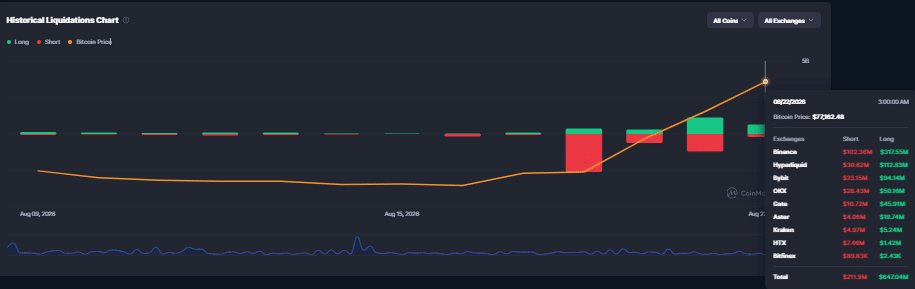
The speed of the decline triggered a cascade of forced selling. Data from CoinGlass showed that 164,899 traders were liquidated over a 24-hour period, with total liquidations reaching $1.02 billion across the crypto market.
Bitcoin futures accounted for $208.73 million of those liquidations, and a striking 93.3% of the wiped-out positions were longs — traders betting on higher prices who were caught offside by the sudden drop.
The flush-out of leverage also showed up in open interest. Aggregate BTC open interest fell 4.7% over just three days, suggesting traders are actively de-risking and reducing borrowed exposure as volatility bites.
Spot ETF Outflows Add to the Pressure
Institutional flows offered little comfort. US-listed spot Bitcoin ETFs recorded $487.07 million in net outflows on Wednesday, while spot Ethereum ETFs saw $160.8 million leave their funds — a sign that even long-term institutional buyers were stepping back in the face of the uncertainty.
The ETF data matters because spot ETFs have been one of the most consistent sources of demand for Bitcoin this cycle. When those flows reverse sharply, it can amplify price moves in both directions.
Key Levels: $80,000, $82,800 and the $84,000–$85,000 Zone
With price hovering just above the big round number, traders are watching a handful of levels closely. The $80,000 mark is the first line of defence — a psychological support level where buyers have stepped in before.
A breakdown below that could open the door to a deeper slide, while a reclaim of $82,800 would be the first sign that the bulls are regaining control. Above that, the $84,000–$85,000 zone looms as a significant resistance area, where sellers are likely to reappear.
Sentiment Sits at Neutral as the Fear and Greed Index Reads 55
Despite the sharp drop, market sentiment has not yet tipped into outright fear. The Crypto Fear and Greed Index stood at 55, squarely in “neutral” territory — suggesting that while traders are nervous, the panic selling has not reached capitulation levels.
What Should UK Investors Do Now?
For UK investors, the first step is to avoid making emotional decisions in the heat of a leveraged sell-off. Forced liquidations like those seen this week often mark short-term extremes, and panicking into a sale after a sharp drop has historically been a poor strategy.
Consider your time horizon: if you are investing for the long term, periods of geopolitical stress have repeatedly proven to be noise rather than signal for Bitcoin’s trajectory. Make sure your position size reflects your risk tolerance, and avoid using leverage unless you fully understand the risk of being liquidated.
It is also worth reviewing your broader portfolio. With gold up nearly 1% on the day, diversification across asset classes continues to show its value. And remember that in the UK, crypto gains may be subject to capital gains tax — so think twice before crystallising losses or gains without considering the tax position.
As always, this is not financial advice. But disciplined, long-term investors will see this week’s $80,000 test as a moment to review strategy — not a reason to panic.